Historical changes
Fork's origin
Divergence point
At this point I wanted to add a lot of menu entries and remove some of the hardcoded defaults.
Two distinct places to send things: Arch packaging (gitlab, the pkgs the installer sits on top of) and archinstall itself (github). Different trackers, different review, different lifetimes.
Arch packaging / Upstreams
Issues tracker:
- Namcap "lots-of-docs"
Reported here
Fixed same week here
CONFIG_DUMMY_CONSOLE_{COLUMNS,ROWS}onsystemdtype hooks vsbusybox
Reported here
Fixed next day here
- Missing deps in
linux-*-headersvariants
Reported here
Fixed same day here
gnupghang ondirmngrcall
Reported here
Fixed a week later here
- Duplicated
.mofiles incoreutilswasting 10 mb
Reported here
Fixed same day here
systemdfailed ISO unit
Reported here
Fixed within weeks.
- DankMaterialShell add
setupcommand and fix keyboard layouts
Reported here
Pending upstream fixes:
- Modify existing
base-develpkg fordoasor alternatives (sudooptional)
Reported here
Archinstall
Sending my patches upstream finally meant the months of testing something privately made sense to other people publicly.
The first step to this is finding a bug, for something I care enough about to devote a lot of time, focus and energy to.
The initial bug I found was that when installing from one computer to another (instead of from a USB), then rebooting it on another machine simply didn't work: it would get stuck at mounting drives for about 2 minutes.
3599 # /etc/fstab boot hanging
Bug was quickly reproduced by a maintainer, which made it worthy of fixing!
Opened this issue on Jun 15th and it got merged on Nov 9th, or 148 days later.
The fix was simply man genfstab and finding the right flag for what I needed:
-f for filter, and repeating the destination.
gen_fstab = SysCommand(f'genfstab {flags} -f {self.target} {self.target}').output()
I had found and patched this in my private repo for months but didn't know how or why to contribute it to public.
Then I wondered: are there other similar commands we miss flags for?
So I looked at other SysCommand calls (about 100 of them in total).
And I found this gem:
pacstrap -C /etc/pacman.conf -K {self.target} {" ".join(packages)} --noconfirm
In the logs of any installation I kept seeing Re-installing x, y,
due to selections having some overlap in dependencies.
Which is normal but useless compute.
So I added --needed and logs properly showed Skipping...,
which I was very happy about.
More features, more problems
Now I have more that got pulled in:
3930 # snapper -> grub integration fix
3928 # vconsole.conf KEYMAP= FONT= mkinitcpio v40 error
3978 # Add host-to-target (H2T) installation mode detection
- Add
running_from_host()function to detect if running from installed system vs ISO - Function checks for
/run/archisoexistence (ISO mode) vs host mode - Add clear logging of installation mode on startup
- Skip keyboard layout changes when running from host system
- Fix Pyright type error in
jsonify()by usingAnyinstead ofobject - Update README to mention installation from existing system
This enables archinstall to be run from an existing Arch installation to perform host-to-target installs on other disks/partitions.
4022 # Do not install base-devel by default
A funny one I'm also very proud of:
base-devel is more of a dev tool than a user's tool.
Building systems should explicitly state it as a dependency
and not assume it's installed by default.
The first line of AUR helpers is often sudo pacman -S git base-devel anyway.
4028 # Adds a timer to post install screen
Because testing should be quick.
4024 # Fix LVM creation/info
Hotfix for LVMs to not hang on Setting up LVM config...,
which I had experienced myself.
4005 # Change LVM /root def to adapt dynamically
Another hotfix where it was 20GiB hardcoded.
4007 # Cache property of graphics_devices
Then it stopped being one bug at a time and became areas.
3979 # Full disclosure for bootloaders/keymaps
4006 # ly.service -> ly@tty1.service
A greeter that never shows up is a black screen. The unit needs the tty instance.
4027 # Set up zram dynamically based on best practice
4042 # zram algorithm config
Hardcoded sizes again.
Then the follow-up: if you expose zram, expose the compressor/decompressor too.
4025 # Enable iwd to be used as back-end in network selection
4031 # Fix mirrors hang when /status endpoint is down
Third-party endpoint down should not stall an installer. Timeout and move on.
4047 # lvm2/LUKS fixes + mirror logic
4043 # Change the order of the main menu
4048 # Language display handled like other sections
Menu order and consistency are not cosmetics here: the order is the install flow a first-timer reads top to bottom.
4074 # Firewalls
4082 # State libfido2 dependency
Implicit deps break the day the pkg that pulled them in drops them. Say it out loud.
4073 # Bootloader changes
4099 # Hotfix: revert grub changes
4100 # Hotfix: firewall
Two hotfixes three days after the features. Worth keeping in the record: shipping to an installer means the blast radius is somebody's unbootable machine, so reverting fast is part of the job, not a failure of it.
4231 # Fix efistub bootloader to use backslashes
EFI paths are DOS paths. / works until firmware decides it doesn't.
4238 # Install gfx before DE/WM/Server
Ordering bug: the desktop pulls its own gfx assumptions if it gets there first.
4358 # Patch plasma profile, add essentials (4336)
4528 # iwd standalone option + fix NM_IWD
NicType.IWD as a third option next to NM and NM_IWD:
iwd does its own DHCP, systemd-resolved picks up DNS through the symlink,
no NetworkManager pulled in.
Also filled in the parse_arg cases so both nic types round-trip through a config file.
4711 # Add linux-rt kernel variants from upstream
4705 # Intel open-source post Gen12 needs this for ffmpeg, obs-studio, etc
4713 # Continue 4705: Intel VPL
Gen12 and up moved to a different media stack. Miss it and hardware accel silently isn't there, which the user only finds out when a recording drops frames. Per the wiki.
You can see all work upstream here, and on gitlab where the more "serious" reports go.
Building in the open
Here is what I've learned by building in the open.
- More issues -> fewer problems long-term
- More users -> more test cases
So how do we bridge this gap?
Devtools
In this category I see two main things:
One: overly complex issue categories, flows, reviews, and codebases, which slow down a project during traction. Backwards-compat claims and style nits that make the code a magical piece instead, too few dare to touch. Instead of a place for fast iteration.
Two: amazing tools that are under-exploited
should be made clearer to likely future contributors,
especially local hooks such as shellcheck, ruff, etc.
Systematic testing
When a patch is released, or when edge occurrences need to be covered, testing has to be done in real-world conditions and from scratch. This, plus logs/notes/screenshots and multiple scenarios, can often take more time than finding the fix in the first place.
It doesn't even account for two more factors: one, you need to understand and dig into the docs of the underlying issue(s) or related; two, you might need to test related changes several times over a matrix.
Open
From a philosophical standpoint this means anyone can get involved, but moreover means they should be given the necessary information to do so.
This shouldn't mean complicated rules but instead welcoming guidelines that enhance success:
-
Issues: user reports from issues AND other sources are the heart of the dev. Taking real experience with a program helps us avoid other similar issues too. This naturally filters future issues to be more critical.
-
Contrib style: in large established codebases you'll likely want to make targeted commits to specifics. Unless you're working on a mega patch (hehehe).
-
Reviews: other maintainers will look at all of the code, and perhaps even test themselves on your branch. Sometimes this means more changes are required, other times it might be logic related.
-
Implications: with each change you make, however personal, you have to grasp other related code. Searching the repo for defs/classes will help you trace, plus tracebacks when hitting errors (and again, proper testing according to changes).
-
Formats: there are certain formats in place that help (simple issue format/categories). Mentioning other PRs/issues/docs in discussions helps with traceability for other peers to look at quickly.
Common issues
Often the best fixes are the ones we know for sure will occur again (reproducible and documented). These are things we see from various sources and can either solve in code or make explicit in docs/UI.
In archinstall an example is that by default the timezone selected is UTC.
If the choice is wrong according to the user's real time
and/or the hardware clock got reset (CMOS battery dead),
then gpg verification of pkgs just fails.
A simple solution is to force the user to select a timezone
by starting at None and making it mandatory, plus adding it to docs.
Speed
Testing is annoying.
Physical tests need you to flash the latest ISOs (monthly), go into BIOS, test install,
grep logs, then reboot and verify.
Sometimes several times for one scenario.
So I thought, while I'm coding, this needs to be faster. Which needed two things:
1. a decent QEMU script to test different scenarios in VMs
(the GUI managers needed more options)
2. an ISO with KDE files so I could test full desktop features in less time.
Made it so the target would have git pre-installed
with the repo already cloned in sudo_user(0) home (very inception like).
Current best time is 1m54s, achieved when I moved all the pkgs with hooks in the installer to the first base-strap. Which you shouldn't do, for obvious reasons.
Weird structure of an OS installer
The archinstall project is especially relevant to me because it covers thousands of use-cases in a TUI that could run on a potato, a small server in your closet or the latest most expensive hardware.
This makes it interesting: it covers a lot of ground, and has many options within (bootloaders, FS types, encryption, UKI, U2F keys, HSM, desktops/servers, etc). These options are philosophy: a good starting point but barebones, due to arch being arch.
This places the installer in a weird position, kind of being downstream from everything.
But at the same time, breaking changes do occur in dev cycles,
meaning testing here becomes both hell and fun.
Notably systemd or other major base libs (mkinitcpio, encryption libs) can break,
or some rules change for x or y.
This is often hotfixed in a few days and back to normal.
And in the end it's kind of upstream of everything,
since different components have similar structure and do kind of compete.
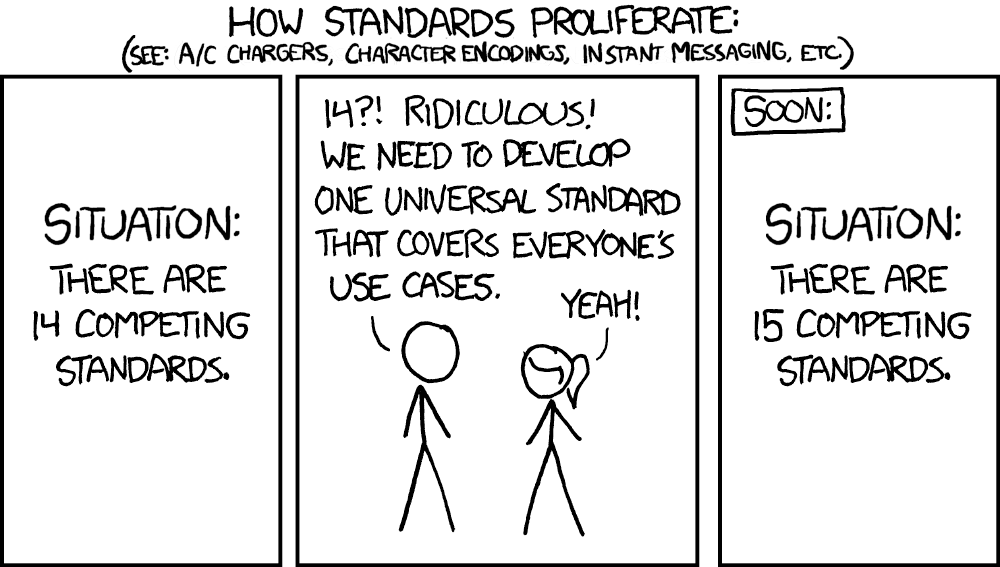
Insert xkcd comic about competing standards.
Archinstall doesn't judge: it gives you all the options and you end up making your pizza. And considering arch packages are basically live updates, let's just say it's fresh.